2026-04-27
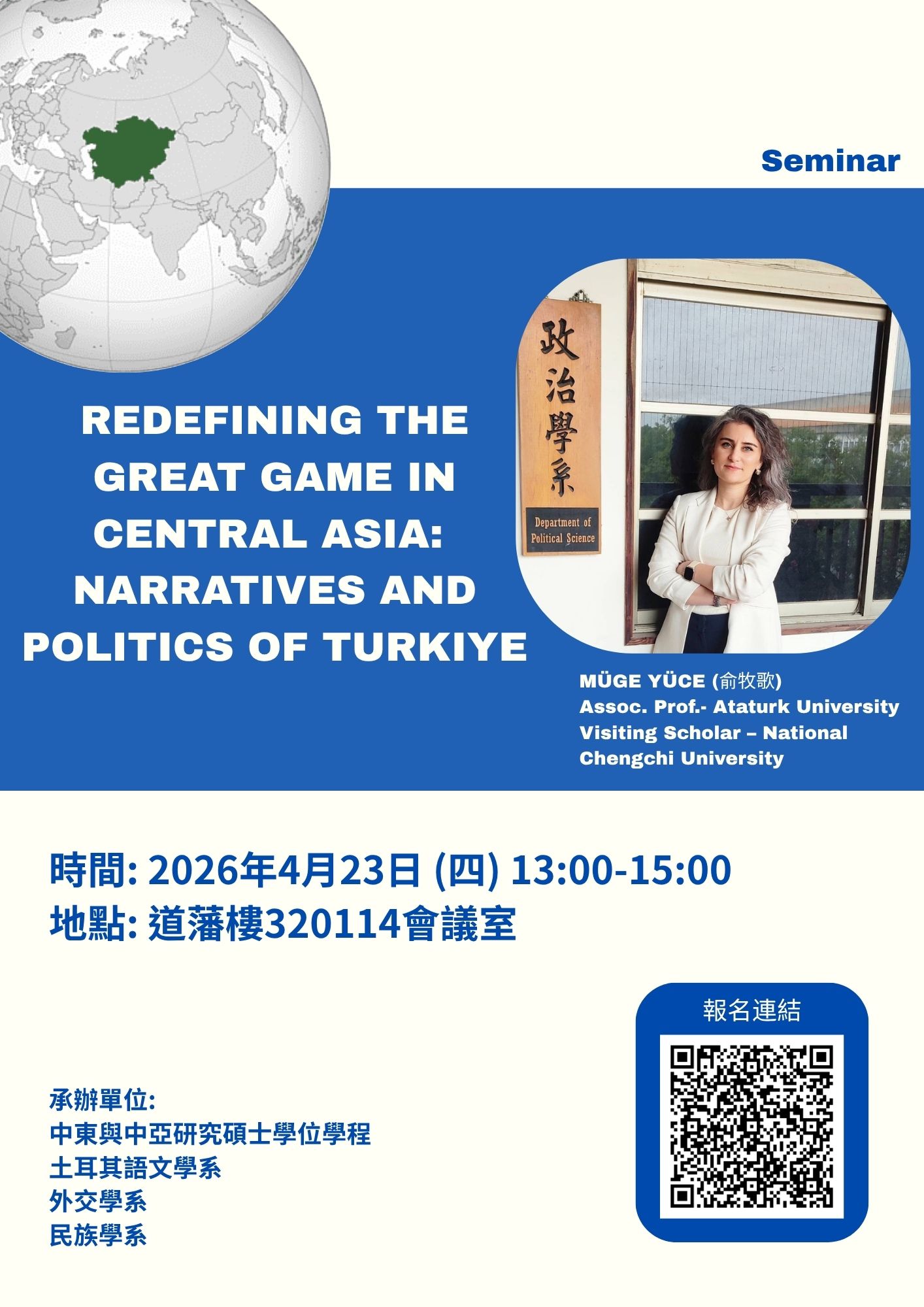
【Seminar】Redefining the Great Game in Central Asia: Narratives and Politics of Türkiye
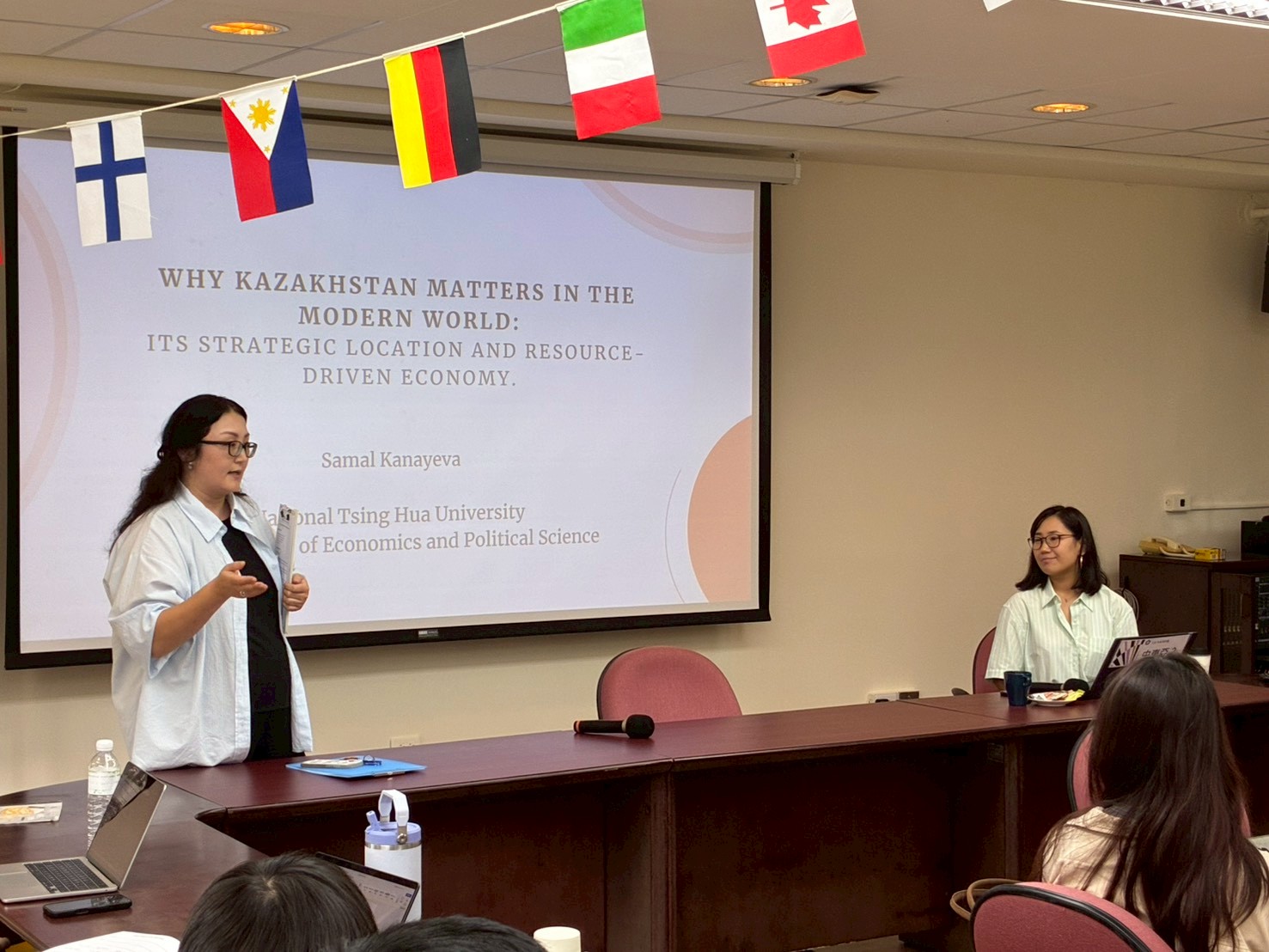
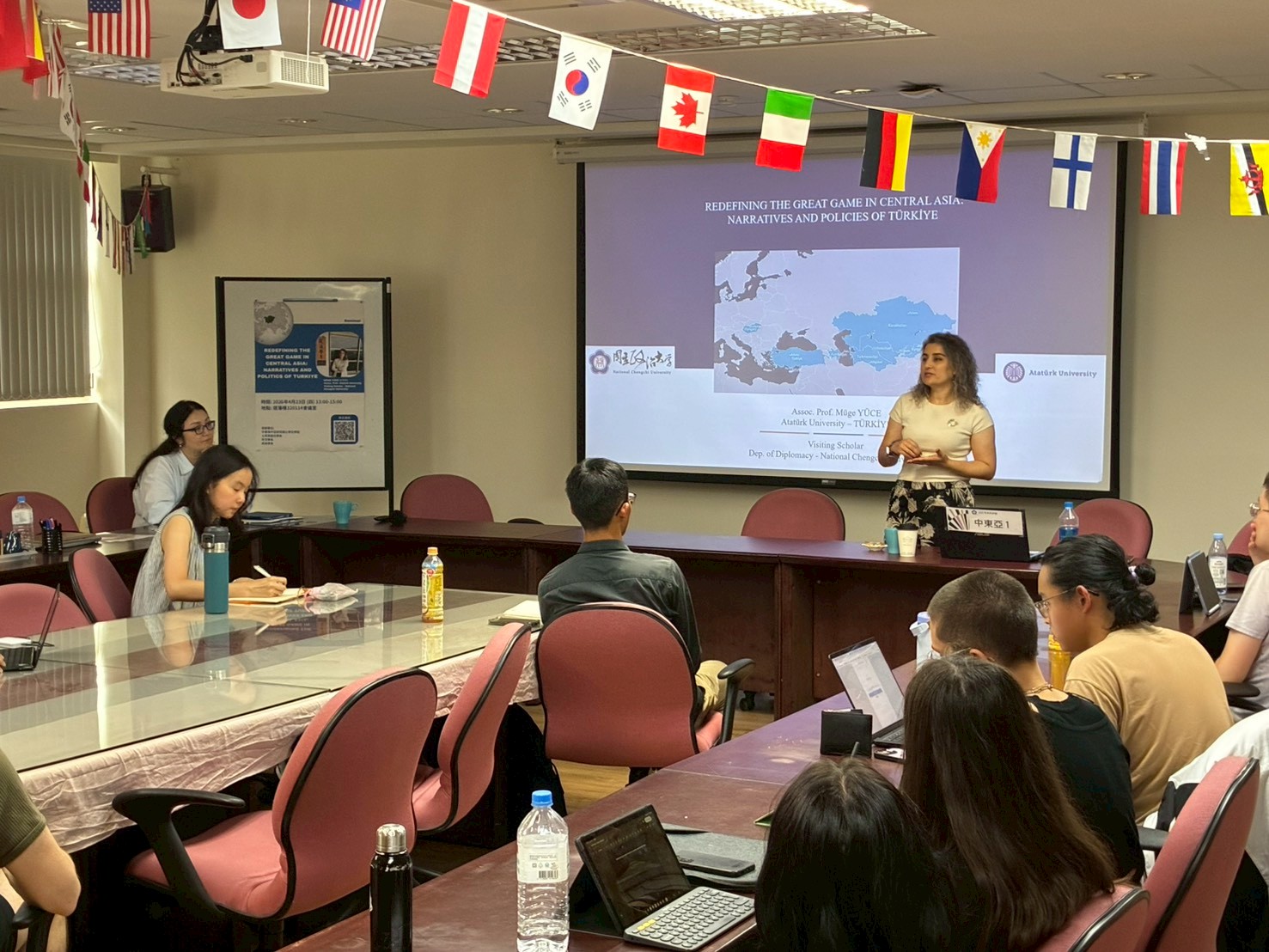
The Master’s Program in Middle Eastern and Central Asian Studies at National Chengchi University hosted a special lecture titled “Redefining the Great Game in Central Asia: Narratives and Politics of Türkiye” on April 23, 2026, at Dao Fan Building. The keynote speaker was Mrs. Müge Yüce, a short-term visiting scholar at NCCU.
At the beginning of the lecture, the speaker provided a historical overview, noting that Türkiye’s official narrative emphasizes Central Asia as the “sacred homeland” and the origin of Turkic peoples. This identity is constructed through both geographical memory (such as the Tianshan Mountains, the Amu Darya River, and the Orkhon inscriptions) and cultural memory (nomadic life, the symbolism of horses, and traditions of hospitality). The migration from Central Asia to Anatolia is framed as a source of legitimacy, with the Battle of Manzikert in 1071 establishing the foundation of a “new homeland.”
The core of the lecture focused on redefining Türkiye’s foreign policy in Central Asia, tracing a continuous yet evolving trajectory from historical memory to contemporary strategy.
Following the Cold War, Türkiye became the first country to recognize the independence of newly sovereign Central Asian states after the dissolution of the Soviet Union, viewing this as an opportunity to expand its geopolitical space. Since the 1990s, Türkiye has strengthened ties with the region through economic aid (via the Turkish Cooperation and Coordination Agency, TİKA), cultural exchange (scholarships, joint universities), and energy cooperation (such as the BTC pipeline).
In terms of neo-Eurasianism and strategic autonomy, Türkiye initially aligned closely with the West in the early 2000s. However, since 2015–2016, it has gradually shifted toward “strategic autonomy,” seeking balance among Russia, China, and the Middle East. The “Asia Anew Initiative” launched in 2019 marked Türkiye’s intent to expand economic and diplomatic cooperation with more than 30 Asian countries, with the “Middle Corridor” project at its core. Türkiye has repositioned itself from a “bridge country” to a “central state,” deepening cooperation through soft Eurasianism and multilateral mechanisms such as TURKSOY, TURKPA, and the Turkic Investment Fund.
In conclusion, the speaker highlighted Türkiye’s current challenges and future outlook. Rapid energy consumption and its geographic position make Türkiye a crucial hub connecting energy suppliers such as Russia, Iran, and Azerbaijan. Yet, tensions with the U.S. and EU, along with limited economic influence compared to Russia and China, underscore Türkiye’s role as a “middle power” in Central Asia. Through educational exchange, diaspora policies, and cultural ties, Türkiye continues to engage with the region, guided by its long-term “Vision 2040.”
During the Q&A session, participants raised questions on bilateral relations and refugee issues. The speaker noted that the Syrian crisis remains severe, with approximately four million Syrian refugees residing in Türkiye, some of whom continue to move toward Europe. While the EU provides financial support to help manage the situation, this arrangement has sparked domestic opposition and concerns over public security.
Other questions addressed Türkiye’s regional role over the past decade, its strategic positioning of the “Middle Corridor,” and competition from countries such as India. The speaker emphasized Türkiye’s dual role in fostering regional connectivity and shaping a new order, balancing between the Shanghai Cooperation Organization and NATO.
On Türkiye’s engagement with BRICS, the speaker clarified that Türkiye is unlikely to abandon NATO, as the alliance remains central to its security and foreign policy. Engagement with BRICS should be seen as an effort to diversify cooperation opportunities rather than a withdrawal from existing alliances.
Additional questions touched on Türkiye’s natural gas supply and relations with African countries. The speaker explained that about 40% of Türkiye’s natural gas is imported from Russia, prompting efforts to diversify energy sources and expand green energy development, though progress remains slow. As for Africa, Türkiye’s direct involvement is limited, though military assistance has been provided in certain regions. More broadly, Türkiye prioritizes connections based on ethnic, religious, and cultural identity, such as cooperation among Turkic states and engagement with issues like Xinjiang, which in recent years has shifted toward civil diplomacy rather than official involvement.
The seminar concluded with a lively Q&A session, followed by opportunities for students to engage in individual discussions with Mrs. Müge Yüce—an apt conclusion to the event.




.jpg)